For clothing wholesalers, fashion retailers, and international importers, finding reliable sources of affordable apparel is one of the biggest challenges in the global fashion industry. Production costs, minimum order quantities, inventory risks, and changing consumer trends can make traditional clothing sourcing difficult.
This is where garment stock lots become an attractive option.
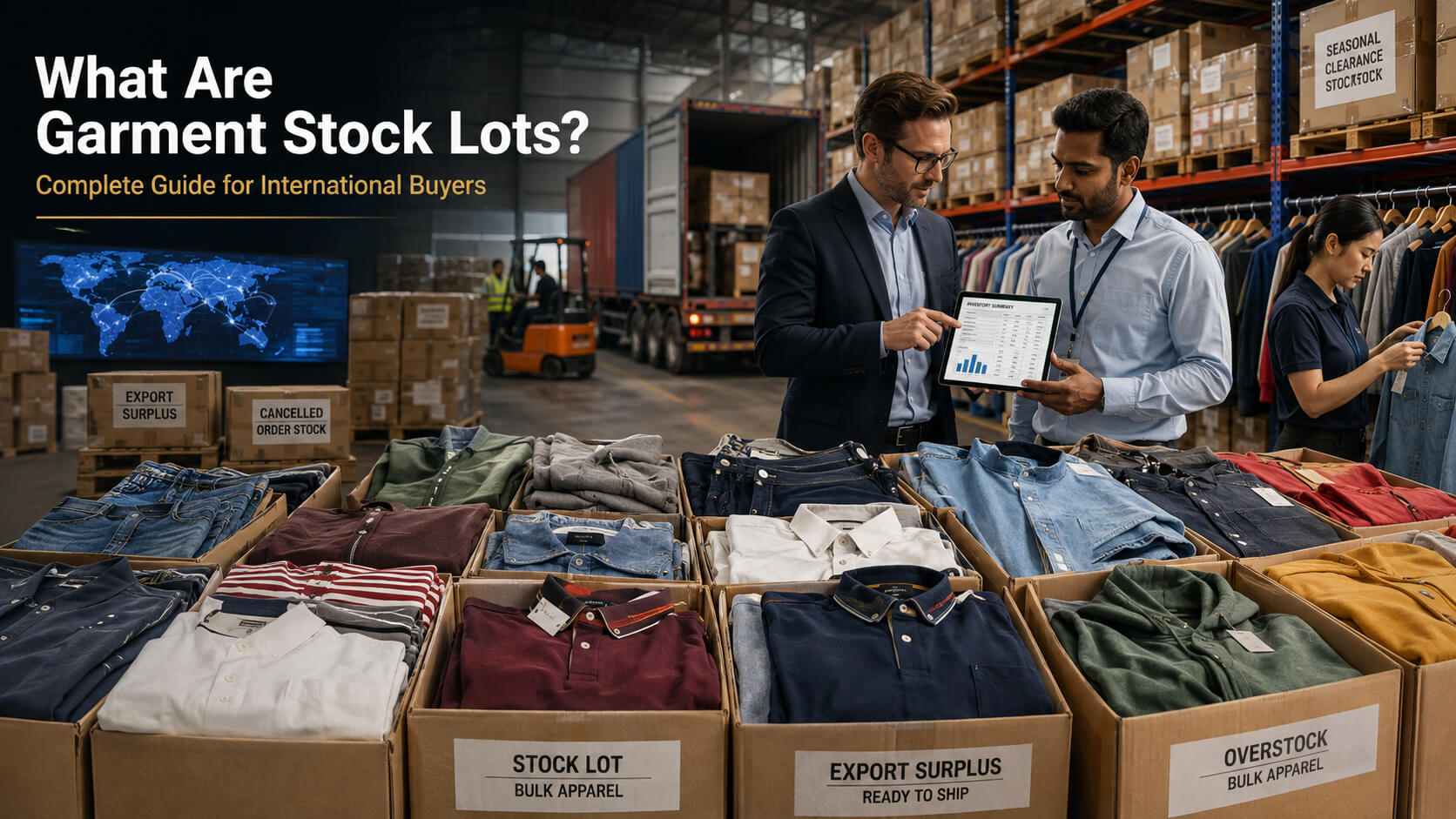
Garment stock lots allow buyers to purchase ready made clothing in bulk at discounted prices. These products are often unused factory surplus garments, export leftovers, cancelled order inventory, seasonal clearance stock, or liquidation apparel. For businesses that need fast inventory access and competitive pricing, stock lots can create valuable sourcing opportunities.
However, successful stock lot purchasing requires more than simply finding a low price. Buyers need to understand where these garments come from, how suppliers classify stock inventory, how quality is checked, and what risks should be considered before placing an international order.
This complete guide explains what garment stock lots are, how the stock lot clothing wholesale market works, how to find trustworthy suppliers, and how international buyers can make smarter purchasing decisions.
Direct Answer: Garment stock lots are bulk quantities of unused clothing sold at discounted prices because they are excess production, cancelled orders, export surplus garments, overstock inventory, or liquidation stock. These products are usually ready made and sold by manufacturers, exporters, and wholesale suppliers to buyers looking for affordable apparel inventory.
What Are Garment Stock Lots?
Garment stock lots are pre-produced clothing items available for wholesale purchase outside the normal manufacturing process.
In standard apparel sourcing, a buyer usually provides:
- Design specifications
- Fabric requirements
- Color preferences
- Size breakdown
- Quantity requirements
- Packaging instructions
The factory then produces the order specifically for that buyer.
With stock lots, the production process has already happened. The buyer purchases existing inventory that is available immediately.
These garments may include:
- T-shirts
- Jeans
- Shirts
- Jackets
- Dresses
- Sportswear
- Children's clothing
- Knitwear
- Outerwear
- Fashion accessories
The main attraction is that buyers can often purchase quality apparel at lower prices compared with creating a new production order.
Why Do Garment Stock Lots Exist?
Many people assume stock lots are only unwanted or defective products. In reality, stock inventory can come from several legitimate business situations.
Understanding the source helps buyers evaluate whether a stock lot is a good opportunity.
1. Factory Surplus Production
One of the most common sources of stock lot apparel is factory surplus.
Clothing manufacturers often produce extra units during production to avoid shortages caused by:
- Quality inspection failures
- Cutting losses
- Manufacturing errors
- Buyer quantity adjustments
Example: A factory receives an order for 50,000 polo shirts. During production, they manufacture 53,000 polo shirts. After shipment, the remaining 3,000 pieces may become factory surplus garments. These products are often completely new and unused.
2. Cancelled Export Orders
Sometimes international buyers cancel orders after production has started.
Reasons may include:
- Market demand changes
- Financial difficulties
- Delayed sales plans
- Collection updates
- Business restructuring
The manufacturer is left with finished goods that need to be sold.
These products often enter the stock lot market as export surplus garments.
3. Retail Overstock Inventory
Fashion retailers frequently purchase inventory based on seasonal predictions.
However, demand does not always match expectations.
Examples:
- A winter collection sells slower than expected
- A fashion trend changes quickly
- A retailer has excess sizes remaining
Instead of keeping unsold inventory, companies may sell it through wholesale stock channels.
4. Brand Liquidation Stock
When businesses close operations, reduce product lines, or restructure their inventory, remaining garments may be sold as liquidation stock.
Garment liquidation stock can include:
- Previous collections
- Discontinued designs
- Excess warehouse inventory
- Store closing merchandise
Types of Garment Stock Lots
The stock lot market includes several categories. Buyers should understand these differences before purchasing.
| Type of Stock Lot | Description | Common Buyers |
| Factory Surplus Garments | Extra products made during manufacturing | Importers and wholesalers |
| Export Surplus Garments | Leftover goods originally produced for export | Global retailers |
| Cancelled Order Stock | Completed products from cancelled orders | Discount sellers |
| Brand Stock Lots | Excess branded inventory | Outlet businesses |
| Seasonal Clearance Stock | Previous season products | Fashion retailers |
| Garment Liquidation Stock | Inventory sold due to business closure | Bargain wholesalers |
Garment Stock Lots vs Regular Wholesale Clothing
Understanding the difference between traditional wholesale clothing and stock lots helps buyers choose the right sourcing method.
| Feature | Regular Wholesale Clothing | Garment Stock Lots |
| Production | Manufactured after order | Already available |
| Customization | Possible | Usually limited |
| Delivery Time | Longer | Faster |
| Product Choice | Flexible | Depends on available stock |
| Minimum Order Quantity | Often higher | Can be lower |
| Pricing | Standard wholesale | Discounted pricing |
For businesses that need specific designs and branding, regular manufacturing may be better.
For buyers who prioritize affordability and quick inventory, stock lots can be a practical solution.
Benefits of Buying Garment Stock Lots Internationally
International buyers choose stock lots because they provide several business advantages.
1. Lower Apparel Sourcing Costs
The biggest advantage of stock lot purchasing is cost efficiency.
Because suppliers already have the inventory, they often sell products below normal wholesale prices.
This helps businesses:
- Increase profit margins
- Offer competitive prices
- Test new product categories
- Reduce production investment
For small retailers and growing wholesalers, this lower entry cost can be valuable.
2. Faster Market Entry
Traditional clothing production requires several stages:
- Product planning
- Fabric sourcing
- Sampling
- Approval
- Manufacturing
- Quality inspection
- Shipping
This process can take weeks or months.
With stock lots, products are already manufactured, allowing buyers to move inventory faster.
3. Access to Export-Quality Clothing
Many garment stock lots come from factories producing apparel for international markets.
Potential benefits include:
- Better manufacturing standards
- Professional finishing
- Quality fabrics
- Export-ready packaging
However, buyers should always verify quality through inspection or samples.
A supplier's claim of "export quality" should be confirmed, not assumed.
4. Lower Minimum Order Requirements
Custom apparel production often requires large minimum orders.
Stock lot suppliers usually sell existing inventory, making it easier for smaller businesses to purchase bulk clothing.
This benefits:
- Boutique owners
- Online fashion stores
- Regional wholesalers
- New importers
Challenges and Risks of Buying Garment Stock Lots
Although garment stock lots can provide excellent sourcing opportunities, international buyers should understand the potential challenges before placing large orders.
A low purchase price does not automatically mean a profitable deal. Successful stock lot buying requires careful evaluation of product quality, supplier reliability, market demand, and shipping considerations.
1. Limited Product Selection
One of the biggest differences between stock lot purchasing and custom manufacturing is limited control.
When buying stock inventory, buyers usually cannot choose:
- Exact colors
- Complete size ratios
- Fabric specifications
- New designs
- Packaging requirements
The available products depend on existing warehouse inventory.
Example: A supplier may offer 20,000 women's jackets. However, the available sizes may include 70% medium, 20% small, and 10% large. If your target market mainly sells larger sizes, this inventory may not perform well.
Before purchasing, always analyze whether the available stock matches your customer demand.
2. Quality Variation
Quality is one of the most important factors when purchasing wholesale surplus clothing.
Not every stock lot has the same quality level.
Some products may be:
- First-quality export goods
- Factory surplus items
- Slightly irregular products
- Customer-return inventory
- Mixed-quality warehouse stock
Professional buyers should request:
- Detailed product descriptions
- High-resolution images
- Product videos
- Fabric information
- Quality inspection reports
- Physical samples when possible
A reliable supplier should clearly explain the condition of the garments.
3. Size and Market Compatibility Problems
Fashion preferences vary significantly between countries.
A clothing size ratio suitable for one market may not work in another.
International buyers should consider:
- Local customer preferences
- Average body measurements
- Seasonal demand
- Fashion trends
- Climate conditions
For example: A buyer importing winter jackets into a tropical region may struggle with slow sales despite receiving a good price.
4. Brand and Label Restrictions
Some garment stock lots contain branded products.
Before importing branded stock, buyers should confirm:
- Ownership rights
- Distribution permissions
- Trademark restrictions
- Destination-country regulations
Selling branded liquidation stock without proper authorization can create legal issues.
Buyers should verify documentation before purchasing branded apparel.
5. Shipping and Import Considerations
International buyers should calculate the complete landed cost, not just the product price.
The total cost may include:
- Product price
- Packaging
- Freight charges
- Customs duties
- Import taxes
- Inspection fees
- Warehouse costs
A cheap stock lot may become expensive if shipping and import costs are underestimated.
How to Buy Stock Lot Garments Internationally: Step-by-Step Process
Buying stock lots successfully requires a structured approach. Follow these steps to reduce risk and improve sourcing decisions.
Step 1: Define Your Buying Requirements
Before contacting suppliers, clearly identify your needs.
Consider:
- Product category
- Target customers
- Preferred price range
- Required quantity
- Destination country
- Seasonal requirements
- Quality expectations
Example: Instead of asking "Do you have cheap clothes?" a professional buyer asks: "I need 5,000 pieces of export surplus cotton T-shirts suitable for the European retail market, mixed sizes, with a target FOB price."
Clear requirements help suppliers provide better offers.
Step 2: Research Reliable Garment Stock Lot Suppliers
Finding the right supplier is one of the most important steps.
Potential sources include:
- Apparel manufacturers
- Export companies
- Stock lot wholesalers
- Clothing liquidation companies
- B2B sourcing platforms
- Industry trade networks
Look for suppliers with:
- Verified business history
- Export experience
- Clear product information
- Professional communication
- References from previous buyers
Avoid suppliers who only provide attractive prices without transparency.
Step 3: Request Detailed Product Information
Before making a purchase decision, ask for complete product details.
Product Details
- Garment category
- Fabric composition
- Available quantity
- Size breakdown
- Color availability
- Country of origin
Commercial Details
- Price per piece
- Minimum order quantity
- Payment terms
- Shipping terms
- Lead time
Quality Information
- Product photos
- Videos
- Inspection documents
- Sample availability
Step 4: Evaluate Samples or Conduct Inspection
For large international orders, inspection is highly recommended.
Quality inspection can check:
- Stitching quality
- Fabric condition
- Color accuracy
- Size consistency
- Packaging
- Defects
Professional buyers often use third-party inspection companies before shipment.
This helps prevent receiving unexpected inventory problems.
Step 5: Calculate Total Landed Cost
Do not evaluate a stock lot only by the supplier price.
Calculate:
Total Landed Cost = Product Cost + Shipping + Duties + Taxes + Additional Fees
Example: A buyer finds shirts at $2 per piece. Additional costs: Shipping $0.40, Import charges $0.30, Handling $0.10. Actual cost: $2.80 per piece.
This calculation gives a realistic profit estimate.
Step 6: Confirm Payment and Shipping Terms
International buyers should understand trade terms before payment.
Common international trade terms include:
| Term | Meaning |
| EXW | Buyer collects goods from supplier location |
| FOB | Supplier delivers goods to shipping port |
| CIF | Supplier covers cost, insurance, and freight to destination port |
| DDP | Supplier handles delivery including duties in many cases |
The best option depends on buyer experience, destination country, and risk preference.
How to Find Reliable Garment Stock Lot Suppliers
Finding trustworthy garment stock lot suppliers requires research and verification.
A good supplier should demonstrate:
1. Industry Experience
Experienced suppliers usually understand:
- Export requirements
- International shipping
- Quality expectations
- Documentation procedures
2. Transparent Inventory Information
Professional stock lot apparel suppliers provide:
- Real inventory photos
- Exact quantities
- Product specifications
- Clear pricing
Be cautious if a supplier refuses to share basic information.
3. Export Capability
International buyers should check whether suppliers can provide:
- Commercial invoices
- Packing lists
- Export documentation
- Shipping support
4. Consistent Communication
Supplier communication is an important trust signal.
Reliable suppliers usually respond clearly regarding:
- Product questions
- Quality concerns
- Shipping details
- Payment procedures
Supplier Verification Checklist
Before placing an order, review the following checklist.
Business Verification
- Confirm company registration information
- Check business history
- Verify physical location
- Review previous export experience
Product Verification
- Request current inventory photos
- Confirm quantity availability
- Check size distribution
- Review quality condition
Transaction Verification
- Confirm payment terms
- Understand shipping responsibilities
- Request official documents
- Use secure payment methods
Practical Example: How a Retailer Can Use Stock Lots
Imagine a small online fashion retailer wants to expand into affordable casual wear.
Instead of investing in a large custom production order, they purchase:
- 3,000 surplus cotton T-shirts
- 1,500 export surplus hoodies
- 2,000 factory surplus jeans
Advantages:
- Lower upfront investment
- Faster inventory availability
- Ability to test customer demand
However, the retailer must still check:
- Size distribution
- Quality consistency
- Market suitability
- Shipping costs
Stock lots work best when buyers combine cost savings with proper evaluation.
Common Mistakes When Buying Garment Stock Lots
Many first-time buyers make mistakes that reduce profitability.
Mistake 1: Choosing Only Based on Price
The cheapest supplier is not always the best option. A lower price may indicate poor quality, mixed inventory, hidden costs, or unreliable service. Focus on overall value, not only purchase price.
Mistake 2: Not Checking Product Quality
Buying thousands of garments without inspection creates unnecessary risk. Always verify material quality, defects, size accuracy, and product condition.
Mistake 3: Ignoring Market Demand
A cheap product does not matter if customers do not want it. Research current trends, customer preferences, seasonal demand, and competitor pricing.
Mistake 4: Ordering Too Much Too Quickly
New buyers should avoid purchasing excessive quantities before understanding supplier quality. A smaller test order can help evaluate product quality, shipping process, and customer response.
Mistake 5: Not Understanding Import Rules
Every country has different requirements for importing apparel. Buyers should verify customs requirements, label regulations, tax obligations, and product restrictions. Always confirm current regulations with official government customs authorities or qualified trade professionals.
Expert Tips and Best Practices for Buying Garment Stock Lots
Successful international buyers do not treat stock lots as simple discount purchases. They approach them as a strategic sourcing opportunity.
The difference between a profitable stock lot purchase and a risky one usually comes down to research, supplier evaluation, and inventory planning.
Below are practical recommendations for buyers who want to build a reliable sourcing process.
1. Build Relationships With Multiple Suppliers
Relying on only one supplier can create problems when inventory availability changes. Professional buyers often maintain relationships with several garment manufacturers, exporters, stock lot wholesalers, and factory surplus suppliers. This gives buyers access to more product options and reduces dependency on a single source.
2. Focus on Product Consistency
A common challenge with stock lots is inconsistent availability. A supplier may have excellent inventory today but limited options next month. Before building a long-term relationship, evaluate product consistency, communication quality, delivery reliability, and documentation accuracy.
3. Understand Your Customer Before Buying
The best stock lot purchase is not necessarily the cheapest one. It is the product that matches customer demand.
4. Request Updated Inventory Lists
Stock lot inventory changes frequently. A supplier catalogue from six months ago may no longer represent available products. Ask suppliers for current stock lists, recent warehouse photos, updated videos, and available quantities.
5. Consider Professional Inspection Services
For large international orders, third-party inspection can be a valuable investment. Inspection companies can evaluate quantity accuracy, product defects, packaging standards, and measurement compliance.
6. Start With a Test Order
New buyers should consider testing a supplier before committing to large volumes. A test order helps evaluate product quality, shipping experience, supplier communication, and customer acceptance.
7. Maintain Proper Inventory Planning
Stock lot purchasing can create opportunities, but businesses still need inventory control. Avoid buying products only because they are cheap. Consider storage costs, expected sales speed, seasonal timing, customer demand, and cash flow requirements.
Garment Stock Lot Buying Strategy for International Buyers
A practical buying strategy can be divided into five stages.
1 Stage 1: Market Research
Before sourcing, analyze current fashion trends, competitor pricing, customer preferences, and seasonal demand.
2 Stage 2: Supplier Selection
Compare multiple suppliers based on product quality, experience, communication, pricing, and export capability.
3 Stage 3: Product Evaluation
Review photos, videos, samples, and inspection reports.
4 Stage 4: Cost Analysis
Calculate product cost, shipping, taxes, import fees, and storage expenses.
5 Stage 5: Inventory Testing
Start with manageable quantities and analyze customer response, sales performance, and profit margins. This approach helps reduce risk while building experience in the stock lot market.
Who Should Buy Garment Stock Lots?
Garment stock lots can be suitable for many types of businesses.
Clothing Wholesalers
Wholesalers can purchase bulk inventory and distribute products to smaller retailers.
Benefits:
- Lower sourcing costs
- Faster stock availability
- Competitive wholesale pricing
Fashion Retailers
Retailers can use stock lots to expand product collections without investing heavily in manufacturing.
Useful for:
- Discount stores
- Online shops
- Outlet businesses
New Fashion Businesses
Startup clothing companies often face budget limitations.
Stock lots allow them to:
- Test product categories
- Reduce initial investment
- Learn customer preferences
Exporters and Distributors
International distributors can use stock inventory to supply regional markets with affordable apparel.
Frequently Asked Questions
1. What are garment stock lots?
Garment stock lots are bulk quantities of unused clothing sold at discounted prices because they are surplus production, cancelled orders, export leftovers, overstock inventory, or liquidation stock. They are commonly purchased by wholesalers, retailers, and international clothing importers looking for affordable apparel sourcing options.
2. Are garment stock lots of good quality?
Yes, many garment stock lots contain high-quality products, especially when they come from established factories producing export garments. However, quality can vary depending on the source. Buyers should request product details, images, samples, or inspection reports before making large purchases.
3. Where can I find reliable garment stock lot suppliers?
Reliable suppliers can be found through apparel manufacturers, exporters, industry networks, trade events, and verified B2B sourcing platforms. Buyers should check supplier experience, export history, product transparency, and customer references before purchasing.
4. What is the difference between stock lot clothing and wholesale clothing?
Stock lot clothing consists of already-produced garments sold from existing inventory, while regular wholesale clothing is usually produced according to buyer requirements. Stock lots usually offer lower prices and faster delivery but provide less customization.
5. Can I buy garment stock lots internationally?
Yes, international buyers can purchase garment stock lots through exporters and wholesale suppliers. However, buyers should understand shipping costs, import regulations, customs requirements, and documentation before completing an international transaction.
6. Are garment stock lots cheaper than manufacturing new clothing?
Usually, garment stock lots are cheaper because suppliers are selling existing inventory rather than producing new garments. However, buyers should compare the total landed cost, including shipping, taxes, and import expenses, before making a final decision.
7. What should I check before buying export surplus garments?
Before purchasing export surplus garments, check supplier credibility, product condition, size availability, fabric quality, documentation, shipping terms, and import requirements. A proper evaluation process reduces sourcing risks.
8. Can small businesses buy garment stock lots?
Yes, small businesses can purchase garment stock lots. Many suppliers offer smaller wholesale quantities compared with traditional manufacturing orders. This makes stock lots suitable for online sellers, boutiques, and new fashion businesses.
Conclusion
Garment stock lots provide international buyers with an opportunity to access affordable apparel inventory without waiting for traditional production cycles.
For wholesalers, retailers, and importers, stock lots can offer several advantages:
- Lower sourcing costs
- Faster inventory availability
- Access to factory surplus garments
- Flexible purchasing opportunities
However, successful buying requires careful supplier selection, quality verification, market research, and proper cost calculations.
The most successful buyers do not simply search for the cheapest clothing. They evaluate product quality, supplier reliability, customer demand, and long-term business value.
When approached strategically, garment stock lots can become a valuable sourcing channel for businesses looking to expand their apparel inventory while managing costs effectively.