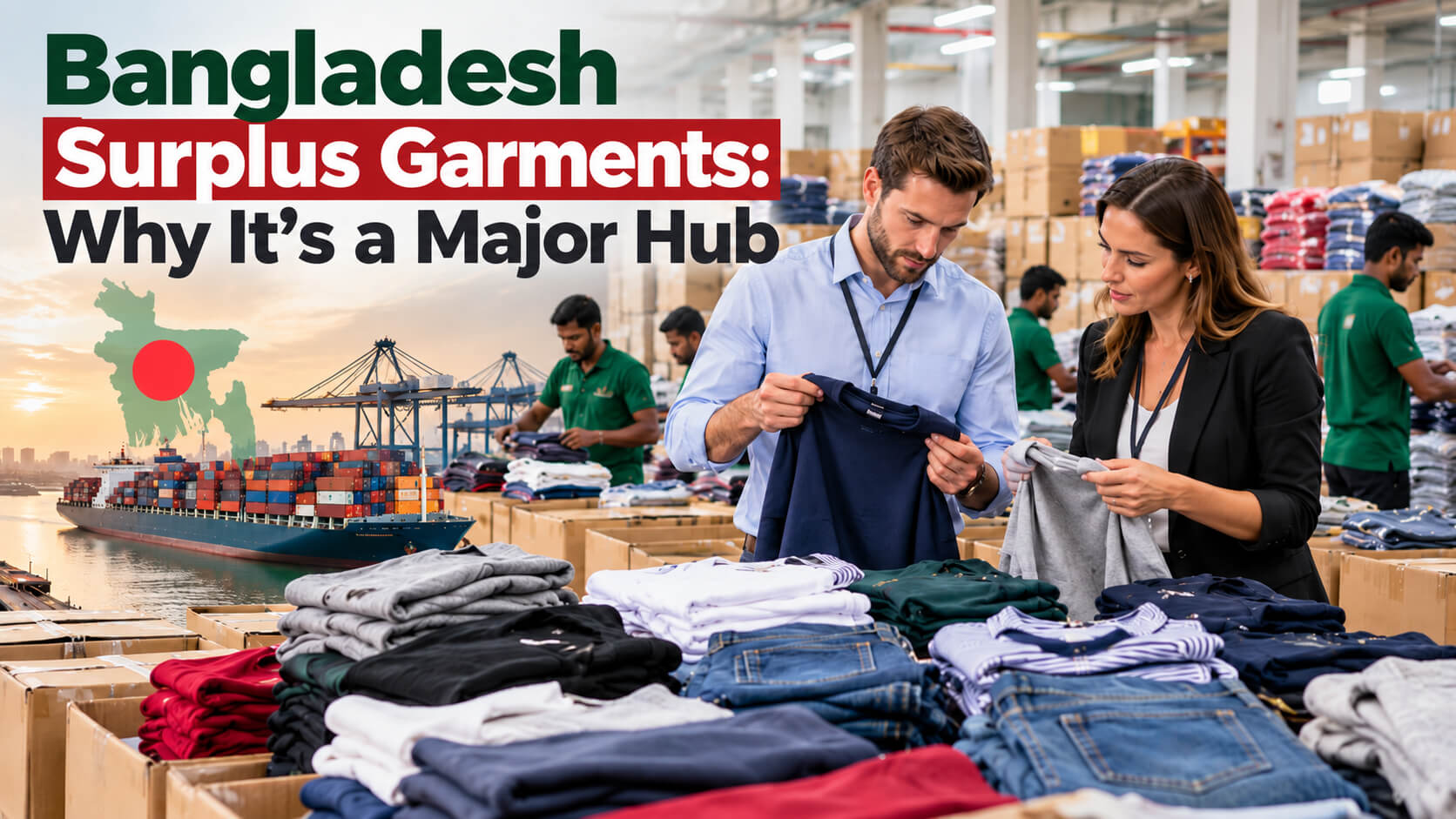
For apparel wholesalers and importers, buying surplus clothing can offer access to ready made inventory without the lead times associated with producing a new order. The challenge is finding a sourcing market with sufficient volume, product variety, competitive pricing, and an established export ecosystem.
That is why Bangladesh surplus garments attract buyers from international wholesale, retail, and distribution markets.
Bangladesh has one of the world's largest export oriented ready made garment industries. BGMEA data shows that the country exported approximately US$39.35 billion in ready made garments during fiscal year 2024 - 25. Such production scale naturally creates opportunities for legitimate excess inventory, order overruns, cancelled orders, samples, and other stock lot merchandise.
This guide explains why Bangladesh has become an important source of garment stock lots, where surplus inventory comes from, what buyers should check, and how to source it more safely.
Direct Answer: Why Is Bangladesh a Major Source of Surplus Garments? Bangladesh is a major source of surplus garments because its enormous export oriented apparel manufacturing sector handles high volume international orders. Production overruns, cancelled orders, excess quantities, samples, specification changes, and unsold export inventory can create stock lots that are subsequently sold through authorized channels to wholesalers and other buyers.
What Are Surplus Garments?
Surplus garments are finished or near finished clothing items remaining outside the quantity ultimately required for an original production order.
Depending on the circumstances, surplus inventory can include:
- legitimate production overruns
- excess quantities manufactured to cover potential defects
- cancelled or reduced orders
- Buyer rejected goods that remain commercially usable
- showroom or approval samples
- Previous season merchandise
- excess inventory held by manufacturers or authorized traders.
The terms surplus garments, stock lot garments, export surplus, and garment stock lot are often used interchangeably in wholesale markets. However, they do not automatically mean the same thing.
A buyer should always establish exactly why the goods are available and whether the seller has the right to sell them.
Why Does Bangladesh Produce So Many Surplus Garments?
1. Bangladesh Has a Large Export Oriented Apparel Industry
The simplest explanation is manufacturing scale.
Bangladesh produces apparel for international markets across categories including knitwear, woven garments, denim, sweaters, T-shirts, trousers, shirts, jackets, children's clothing, and other products.
BGMEA reports ready made garment exports of about US$39.35 billion for fiscal year 2024–25, illustrating the volume moving through the country's apparel production system.
At this scale, even a relatively small excess percentage across thousands of individual production runs can create significant volumes of available stock.
This is one reason buyers searching for surplus garments in Bangladesh can encounter everything from several cartons of one style to much larger quantities of mixed apparel.
2. Factories Often Need Production Buffers
Garment production rarely works by cutting and sewing exactly the ordered number of pieces.
Suppose a buyer orders 100,000 T-shirts. A factory may need additional material and production capacity to compensate for issues such as:
- cutting defects
- sewing defects
- fabric faults
- shade variation
- damaged pieces
- inspection failures
- Size ratio adjustments.
The exact production practice varies by factory, buyer agreement, product, and quality requirement.
If the final shipment is completed successfully and permitted excess units remain, some of those garments may eventually enter the surplus market.
This does not mean every factory overrun can legally be resold. Buyer agreements, intellectual property rights, labeling requirements, and disposal instructions may restrict what happens to excess units.
3. Order Cancellations and Quantity Changes Create Stock Lots
Global apparel orders can change after production has already started.
A retailer might reduce an order because of weaker demand, changes in seasonal plans, inventory pressure, delivery delays, financial problems, or other commercial reasons.
If goods have already been cut, sewn, finished, or packed, the manufacturer may be left holding inventory.
When contractual and legal conditions allow it, these garments can become Bangladesh stock lot garments available to other buyers.
For wholesalers, such lots can be attractive because the goods already exist. They may therefore be available considerably faster than a newly manufactured order.
4. Bangladesh Produces a Wide Range of Apparel
Another reason Bangladesh works well for stock lot sourcing is product diversity.
A buyer may find surplus inventory in categories such as:
| Garment category | Common sourcing opportunity |
| T-shirts and polos | Large-volume basic stock |
| Hoodies and sweatshirts | Seasonal and casualwear lots |
| Denim | Jeans, shorts and jackets |
| Shirts | Men's and women's woven styles |
| Trousers | Casual and formal bottoms |
| Kidswear | Mixed styles and size ranges |
| Sweaters | Seasonal knit products |
| Jackets | Outerwear and lightweight jackets |
Actual availability changes constantly. Unlike regular production, stock lots cannot usually be reordered in identical specifications after the available quantity is sold.
Why Do International Buyers Source Bangladesh Surplus Garments?
Competitive Buying Opportunities
Stock lot merchandise is normally being cleared rather than manufactured against a fresh purchase order.
As a result, buyers may obtain commercially attractive prices compared with commissioning an equivalent new production run.
However, buyers should compare more than unit cost.
The relevant calculation is closer to:
Purchase price + inspection + sorting + inland transport + freight + duties + losses from defective or unsuitable pieces.
A cheap lot can become expensive if a high percentage is damaged, incorrectly sized, commercially restricted, or unsuitable for the destination market.
Immediate or Shorter Availability
Regular apparel production can involve fabric sourcing, lab dips, samples, approvals, cutting, sewing, finishing, inspection, and shipment.
A finished garment stock lot in Bangladesh has already completed most or all of those steps.
For buyers supplying discount stores, online sellers, market traders, regional wholesalers, or off price retail channels, shorter sourcing cycles can be a significant advantage.
Flexible Quantities
Some stock lots are large, while others contain comparatively modest quantities.
This can make surplus sourcing useful for buyers who cannot commit to the minimum order quantities required for custom garment production.
The trade off is limited consistency: buyers generally need to accept the colors, specifications, sizes, and quantities that physically exist.
Surplus Garments vs. Regular Production: What Is the Difference?
| Factor | Surplus/stock lot | Regular production |
| Availability | Existing inventory | Made after ordering |
| Lead time | Usually shorter | Usually longer |
| Customization | Very limited | High |
| Colors and sizes | Based on available stock | Buyer-selected |
| Quantity | Fixed by available lot | Negotiated production quantity |
| Repeat orders | Often impossible | Usually possible |
| Pricing | Can be highly competitive | Based on specification and MOQ |
| Inspection | Essential before purchase | Controlled during production |
| Branding issues | Require careful verification | Established in buyer contract |
Neither model is automatically better.
Wholesale surplus garments from Bangladesh make sense when price, fast availability, and flexibility matter more than exact specifications or repeatability. Regular production is usually better when a buyer needs consistent designs, controlled sizing, private labeling, and ongoing replenishment.
How Does the Bangladesh Stock Lot Supply Chain Work?
A typical transaction can be understood in five steps.
Step 1: Stock Becomes Available
Inventory may originate from excess production, a cancelled order, surplus quantities, samples, or another legitimate source.
Step 2: The Lot Is Documented
A reliable seller should be able to provide basic information such as:
- item description
- quantity
- size breakdown
- colors
- fabric composition where known
- packing details
- condition
- photographs or videos
- origin and authorization information where relevant.
Step 3: The Buyer Reviews the Goods
Serious buyers should request samples or arrange physical inspection rather than purchasing solely from photographs.
Step 4: Commercial Terms Are Confirmed
Both sides agree on quantity, grading, price, packing, payment terms, inspection conditions, shipment terms, and documentation.
Step 5: Goods Are Inspected and Shipped
The buyer or an appointed third party inspector verifies the merchandise before release or shipment.
For new supplier relationships, inspection before final payment or shipment can significantly reduce sourcing risk.
Practical Example: Evaluating a Stock Lot
Imagine an importer is offered 20,000 cotton T-shirts at an attractive wholesale price.
Instead of immediately comparing the offer with factory production prices, the buyer should ask:
- Why is the stock available?
- Is the quantity physically in the warehouse?
- Are all 20,000 pieces the same quality grade?
- What is the size ratio?
- How many colors and styles are included?
- Are any garments defective?
- Do the products carry brand names or trademarks?
- Does the supplier have authority to sell them?
- Can an independent inspection be arranged?
- What documentation will accompany the shipment?
A slightly more expensive lot with documented origin, stable sizing, low defect rates, and clear resale rights may deliver a better commercial result than the cheapest quotation.
How Should You Choose a Stock Lot Garments Supplier in Bangladesh?
Choosing a stock lot garments supplier Bangladesh buyers can rely on requires more than reviewing product photos.
Verify the Business
Confirm the legal identity, physical location, export capability, and commercial history of the company.
Where appropriate, request relevant company registration and export documentation.
Ask for Real Time Stock Evidence
Stock lot markets move quickly. Images can be outdated or reused.
Ask for current warehouse videos, packing list information, identifiable lot details, or a live video inspection where practical.
Inspect Before Shipping
Check a representative sample for:
- measurements
- sewing quality
- stains
- holes
- color differences
- print defects
- broken zippers or buttons
- incorrect labels
- packing condition
- size assortment.
Confirm the Grade
The word "surplus" does not automatically mean first quality merchandise.
Ask whether goods are:
- first quality
- Minor defect
- seconds
- rejected merchandise
- mixed grade
The condition should be recorded in the purchase agreement.
Verify Brand and Trademark Rights
This is particularly important for branded surplus garments Bangladesh sellers may offer.
A brand label inside a garment does not by itself prove that the product can legally be resold or exported.
Buyers should establish the merchandise's origin and the seller's authority to dispose of it. Trademark, parallel import, customs, distribution, and labeling rules can differ by destination country. Obtain appropriate legal or customs advice for branded goods when necessary.
What Common Mistakes Should Stock Lot Buyers Avoid?
The most frequent mistakes are related to verification rather than price.
Buying from photographs alone
Images may not reveal defects, inconsistent sizing, mixed grades, or actual available quantity.
Focusing only on price per piece
Freight, customs charges, inspection fees, unusable inventory, and sorting costs affect the real landed cost.
Ignoring size ratios
A 10,000 piece lot may appear attractive until the buyer discovers that commercially difficult sizes represent a large percentage.
Assuming "export quality" is a formal quality grade
Ask for measurable specifications instead of relying on broad marketing terminology.
Failing to verify branded merchandise
Unauthorized branded stock can create intellectual property and customs problems.
Expecting repeat availability
Stock lots are opportunistic. Once a lot sells, the same garment may never become available again.
Skipping pre shipment inspection
The cost of inspection can be far smaller than the cost of receiving a container of unsuitable merchandise.
Expert Best Practices for Bangladesh Apparel Sourcing
For buyers evaluating surplus clothing suppliers Bangladesh, use a repeatable sourcing process rather than treating every transaction as an isolated bargain.
Use a Stock Lot Buying Checklist
Before confirming an order, document:
supplier identity
exact available quantity
garment category
size ratio
color ratio
quality grade
fabric composition
defect allowance
branding status
unit price
Incoterm
inspection terms
payment terms
packing method
shipping documents.
Build Relationships With Reliable Suppliers
Because availability changes rapidly, established sourcing relationships matter.
A trusted sourcing company or supplier can alert buyers when suitable stock becomes available instead of requiring the buyer to search from zero for every order.
Match Stock Lots to the Right Sales Channel
Surplus garments work particularly well for business models that can handle changing assortments.
Examples include:
- Off price retailers
- wholesalers
- discount chains
- online clearance sellers
- outlet stores
- regional distributors
- independent retailers
They are less suitable for retailers that require identical replenishment of the same SKU throughout the year.
Is Bangladesh a Reliable Country for Apparel Sourcing?
Bangladesh has a mature export oriented apparel ecosystem serving international buyers, but supplier level due diligence remains essential.
Better Work Bangladesh, an ILO and IFC initiative reports that its program currently works with hundreds of participating factories and dozens of international brands and retailers. Its work covers factory assessment, advisory services, worker conditions, compliance, and competitiveness.
That broader ecosystem is relevant to Bangladesh apparel sourcing, but buyers should not assume that every manufacturer, trader, or stock lot supplier operates to the same standard.
A country's manufacturing reputation does not replace individual supplier verification.
Key Takeaway
Bangladesh offers scale, product diversity, export experience, and substantial apparel manufacturing capacity. The strongest sourcing results come when buyers combine those advantages with inspection, documentation, supplier due diligence, and realistic expectations about stock lot availability.
Frequently Asked Questions
Why are surplus garments available in Bangladesh?
Surplus garments are available because Bangladesh produces apparel at a very large scale for export markets. Excess production, order reductions, cancellations, samples, quality sorting, and leftover quantities can create stock lots. The reason varies from lot to lot, so buyers should confirm the origin and resale status before purchasing.
Are Bangladesh stock lot garments cheaper than new production?
They can be cheaper, but not every stock lot is automatically a bargain. Sellers may price existing inventory competitively because it needs to be cleared. Buyers should calculate total landed cost, including inspection, freight, duties, sorting, and defective pieces, rather than comparing only the quoted price per garment.
Can I buy branded surplus garments from Bangladesh?
Potentially, but branded merchandise requires additional verification. Buyers should confirm authenticity, ownership, the seller's right to dispose of the goods, and applicable trademark or customs restrictions in the destination market. A recognizable label does not by itself establish that a stock lot is authorized for resale.
What is the minimum order quantity for surplus garments in Bangladesh?
There is no universal minimum order quantity for stock lots. MOQ depends on the seller, product, available inventory, packing arrangement, and whether the supplier is willing to split a lot. Some lots may contain a few thousand pieces, while others can involve substantially larger quantities.
How can I find reliable surplus clothing suppliers in Bangladesh?
Start by verifying the supplier's legal business details, physical presence, stock ownership, export experience, and references. Request current stock evidence and detailed packing information, then arrange samples or a third party inspection. Avoid relying only on social media photographs, unusually low prices, or verbal assurances.
What should I inspect before buying a garment stock lot?
Check quality, measurements, quantity, size ratio, colors, fabric, workmanship, labeling, defects, and packing. For mixed lots, determine whether every carton contains the same quality grade. For branded products, also verify authenticity and resale authorization before arranging international shipment.
Can export surplus garments from Bangladesh be reordered?
Usually not in exactly the same form. Stock lots are based on existing inventory, so once the merchandise is sold, identical styles, colors, and size ratios may no longer be available. Buyers requiring continuous replenishment should consider regular production rather than relying exclusively on surplus inventory.
Is stock lot sourcing suitable for every apparel business?
No. It works best for wholesalers, discount retailers, outlet businesses, and distributors able to sell changing assortments. Businesses requiring private labels, exact specifications, predictable size ratios, seasonal consistency, or repeat SKUs are generally better served by planned garment production.
Conclusion
Bangladesh's position as a large export oriented apparel manufacturing base makes it a logical market for garment stock lots. High production volumes, changing buyer requirements, cancelled orders, samples, and legitimate excess quantities can all contribute to the supply of Bangladesh surplus garments.
For international buyers, the opportunity is not simply "cheap clothing." The real advantage is access to existing apparel inventory that may combine competitive pricing with shorter availability and flexible quantities.
Those benefits come with specific risks. Stock cannot always be repeated, quality can vary, size ratios may be uneven, and branded products require careful verification.
The most effective approach is therefore straightforward: verify the supplier, understand why the goods are available, inspect the actual merchandise, document quality and quantity, confirm resale rights where relevant, and calculate the complete landed cost before purchasing.
For wholesalers and distributors able to work with opportunistic inventory, Bangladesh can be a valuable part of a diversified apparel sourcing strategy.
Ready to source surplus garments from Bangladesh? Contact Spider Textile today. Get a Quote