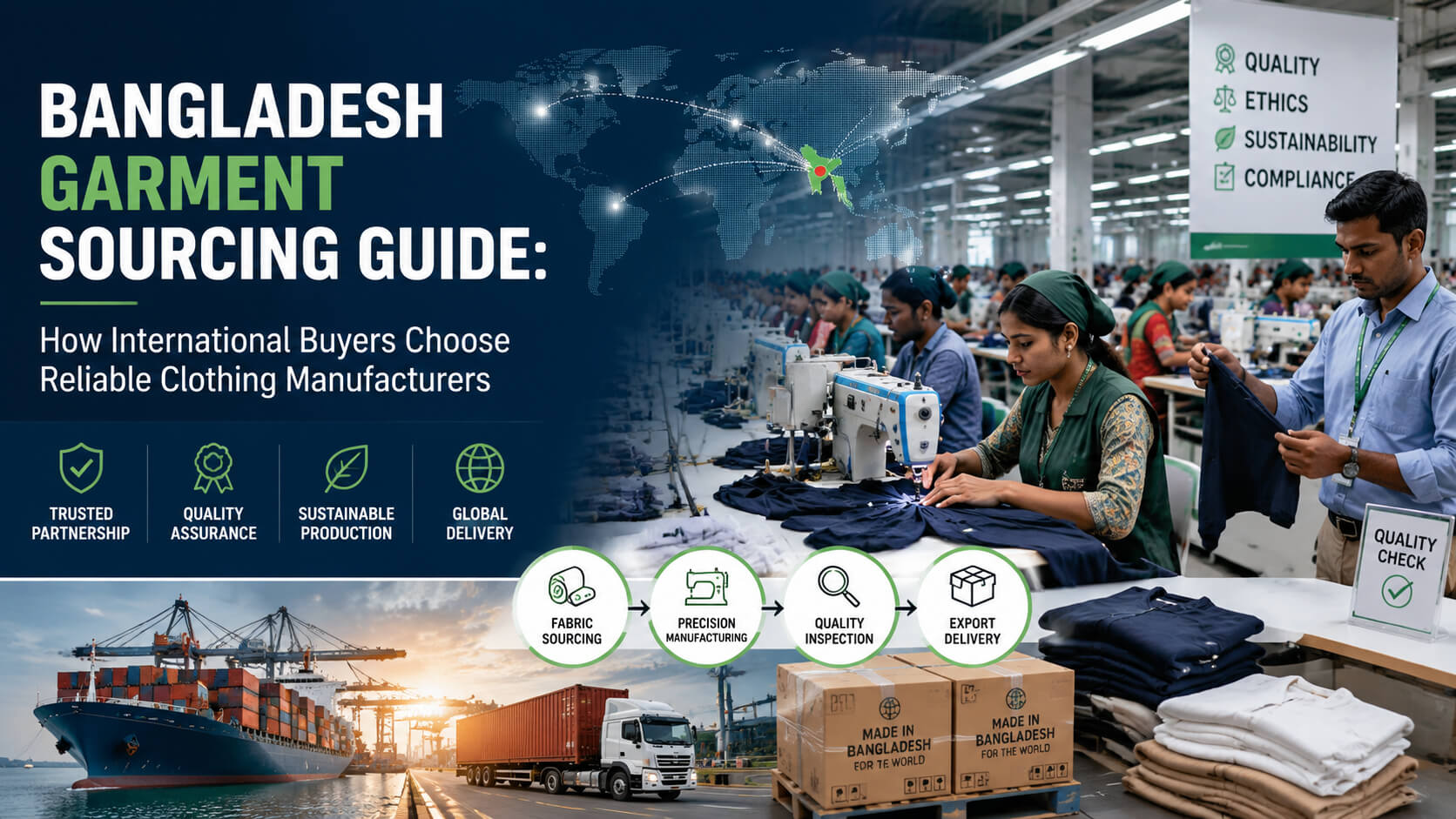
Bangladesh is one of the world's most established apparel manufacturing destinations, but having thousands of potential suppliers does not make choosing the right one simple.
International buyers must evaluate much more than unit price. Production capability, product specialization, minimum order quantities, quality systems, compliance, sampling, communication, lead times, commercial terms, and factory safety can all affect whether an order succeeds.
This Bangladesh Garment Sourcing Guide explains how international apparel buyers, fashion brands, retailers, wholesalers, importers, and sourcing managers can identify suitable manufacturers, verify suppliers, compare sourcing models, manage production risk, and build more reliable supplier relationships.
It also explains when working directly with a factory makes sense and when a Bangladesh garment buying house or sourcing partner may provide better operational support.
Direct Answer: International buyers should source garments from Bangladesh by defining clear product specifications, identifying manufacturers with relevant production experience, verifying their legal and operational credentials, reviewing compliance and factory safety records, requesting samples, comparing detailed quotations, conducting quality inspections, and agreeing on written production, payment, delivery, and corrective action terms before placing bulk orders.
Bangladesh has developed a deep ready made garment manufacturing ecosystem covering knitted and woven apparel, sweaters, denim, casualwear, shirts, trousers, outerwear, childrenswear, and many other product categories.
The World Trade Organization's Bangladesh trade profile shows exports across major apparel categories including cotton trousers, jerseys and pullovers, shirts, synthetic trousers, and other knitted and woven garments.
For international buyers, the attraction is not simply lower manufacturing cost. The more important advantage is the depth of the supply chain. Depending on the manufacturer and product category, buyers can potentially access: The official Bangladesh Garment Manufacturers and Exporters Association directory currently contains more than 4,000 member listings, demonstrating the breadth of the industry. Membership alone, however, should never be treated as proof that a supplier is suitable for a specific order. Garment sourcing in Bangladesh is often attractive when a buyer: Bangladesh may be less suitable for an early stage brand seeking extremely small quantities, highly experimental products, or repeated last minute design changes unless the buyer finds a manufacturer specifically structured for that business model. Key takeaway: Bangladesh offers considerable manufacturing depth, but buyers gain the most value when their order profile matches the capabilities and commercial structure of the selected factory. Bangladesh apparel manufacturers serve a wide range of international categories. Commonly sourced products include: Examples include: Knit production can be particularly attractive where factories or manufacturing groups have integrated knitting, dyeing, finishing, and garment production capabilities. Common products include: When comparing woven clothing manufacturers in Bangladesh, buyers should check whether the factory regularly handles the required fabric construction, garment wash, trims, and sewing complexity. Bangladesh has manufacturers serving categories such as: For denim orders, washing capability is particularly important. A factory that can sew a product is not necessarily qualified to achieve a specific wash, shade, abrasion, hand feel, or finishing effect consistently. Flat knit sweater manufacturers may produce: Gauge, yarn composition, knitting machinery, linking capability, washing, and finishing should all form part of supplier evaluation. Private label clothing manufacturers in Bangladesh can produce garments under a buyer's own brand, subject to the factory's capabilities and order requirements. Services may include: Do not assume every exporter offers a complete private label service. Ask which elements are performed in house, which are subcontracted, and which must be supplied or approved by the buyer. A structured sourcing process reduces the risk of choosing a supplier based solely on price or marketing claims. Before contacting Bangladesh clothing suppliers, prepare a concise sourcing brief. Ideally, it should include: A detailed tech pack helps suppliers quote more accurately. If your brief only says, "I need 5,000 premium cotton T shirts," different factories may quote completely different yarn counts, fabric weights, finishing processes, stitching standards, packaging, and testing assumptions. The quotations will not be directly comparable. Potential Bangladesh garment manufacturers can be identified through: The Bangladesh Export Promotion Bureau maintains an exporter database that includes company, factory, location, product, and HS code information for registered exporters. BGMEA also maintains a member directory. In 2026, BGMEA announced a partnership with Open Supply Hub to improve factory mapping and supply chain transparency for member factories. Use directories to create a shortlist not as a replacement for due diligence. One of the most common sourcing mistakes is choosing a large or impressive factory that is poorly matched to the product. Ask: A manufacturer that specializes in high volume basic T shirts may not be the best supplier for complex fashion garments requiring frequent material changes and low quantities. Before placing an order, verify the company behind the quotation. Depending on the transaction, checks can include: Where relevant, cross check information against sources such as the Export Promotion Bureau, BGMEA, BKMEA, Better Work Bangladesh, and factory safety databases. The RMG Sustainability Council provides information on remediation progress for factories covered by its safety system, including structural, electrical, and fire safety remediation status. Verification matters because a polished website or sales presentation does not prove where or by whom your garments will actually be produced. Sampling helps determine whether the supplier understands the product. A typical development process may involve: The exact process varies by product and buyer. Do not approve a sample simply because it "looks good." Check it against measurable requirements. Review: Keep an approved reference sample wherever practical. The lowest quoted unit price is not necessarily the lowest total sourcing cost. Compare: For example, an FOB quote and an EXW style factory price are not directly comparable. Ask the supplier to clearly state what is included. The level of due diligence should reflect order value, product risk, buyer requirements, and the length of the expected relationship. A physical or qualified third party assessment can review: Better Work Bangladesh assesses participating factories against national labor law requirements and international labor standards across areas including compensation, working time, contracts, occupational safety and health, discrimination, child labor, forced labor, and freedom of association. An audit should be treated as one piece of due diligence, not a guarantee of future performance. Before bulk production, document: For substantial orders, obtain appropriate professional advice on contracts, customs, taxes, labeling, product safety, and destination market requirements. Do not disappear between purchase order confirmation and final inspection. Establish milestones for: Early visibility gives the supplier and buyer more time to correct problems. Final inspection should confirm whether completed goods meet the agreed specification before they leave the supplier. Depending on the product, inspection may cover: For higher risk orders, buyers may also use fabric inspections, inline inspections, or production monitoring rather than relying solely on final inspection. There is no universally better model. The right choice depends on the buyer's experience, order size, product mix, and ability to manage suppliers. Direct sourcing may be preferable when: A capable buying house can help with: The important question is not whether an intermediary is involved. It is what measurable work the intermediary performs and whether the buyer retains adequate supply chain visibility. Ask whether your order will be placed in an approved factory and whether subcontracting requires written authorization. Use a supplier scorecard rather than relying on instinct. A simple framework can include: Relevant products, materials, techniques Machines, lines, monthly capacity, planning QC procedures, defect control, inspections Current documentation and corrective actions Structural, fire, electrical status where applicable Price, MOQ, payment, Incoterm Accuracy and response speed Clarity, ownership, responsiveness Realistic production plan Factory identity and subcontracting Ability to support future volume Do not assign equal weight to every category. A buyer of childrenswear, for example, may place greater emphasis on product safety controls and traceability. A fast fashion business may prioritize development speed and production flexibility. A basic program retailer may prioritize capacity planning and repeatability. There is no single certificate that proves a garment factory is suitable. The documents you need depend on your market, customer requirements, product type, and sourcing policy. Factories may participate in or hold documentation related to areas such as: Programs and standards encountered in international apparel sourcing may include Better Work, RSC related safety processes, OEKO TEX, GOTS, GRS, amfori BSCI, Sedex/SMETA, WRAP, ISO systems, or buyer specific programs. These terms should not be treated as interchangeable. For example, an audit focused on labor practices does not automatically prove that a fabric meets a particular chemical or organic content standard. Before relying on a certificate or audit: Standards, regulations, buyer requirements, and factory status can change. Verify current requirements before order placement. There is no standard MOQ for Bangladesh garment manufacturing. Minimum order quantity depends on factors such as: A factory might be technically capable of sewing a small order but still reject it because the fabric mill, dye house, printer, or trim supplier requires a larger minimum. Consider: If you are building a new fashion label, ask about MOQ before spending heavily on sampling. Garment prices are built from multiple inputs. Major factors include: Instead of asking, "What is the cheapest price?", ask: "What specification is this price based on?" A lower quotation may reflect a lighter fabric, different yarn, simpler construction, cheaper trims, lower testing requirements, or different commercial terms. Suppose two suppliers quote a cotton hoodie. Supplier A appears cheaper. Supplier B includes: Until both factories quote exactly the same specification, the price comparison has limited value. Consider an overseas retailer planning 10,000 custom T shirts. Instead of sending a photo and requesting "best price," the buyer prepares: The buyer then shortlists five potential suppliers. After supplier verification and initial discussions: Rather than choosing automatically on unit price, the buyer compares sample quality, manufacturing fit, lead time, compliance documentation, production transparency, payment terms, and communication. This process takes more effort upfront but reduces the risk of discovering serious mismatches after bulk materials have already been purchased. Low unit cost provides little value if quality failures, delays, rework, rejected stock, or airfreight costs follow. Compare total commercial risk, not only FOB price. Vague inquiries produce vague quotations. Better specifications create better supplier comparisons. Garment factories in Bangladesh vary substantially in machinery, product expertise, capacity, management systems, and target customers. Choose specialists where possible. Certificates expire. Audit findings change. Factory performance changes. Verify current documentation. Ask whether any cutting, sewing, printing, embroidery, washing, finishing, or packing will be subcontracted. Unapproved subcontracting can create quality, compliance, and traceability risk. A rushed sample approval can turn a small development problem into thousands of defective units. Document approval points. Payment fraud and unauthorized account changes are risks in international trade generally. Verify beneficiary information through established contacts and internal controls before sen
Why Do International Buyers Source Garments from Bangladesh?
When is Bangladesh particularly suitable?
What Products Can You Source from Bangladesh Garment Manufacturers?
Knitwear
Woven Garments
Denim
Sweaters and Knitwear
Private Label Apparel
How to Source Garments from Bangladesh Step by Step
1. Create a Clear Product Specification
2. Build a Longlist of Potential Suppliers
3. Match the Factory to Your Product
4. Verify the Supplier
5. Request Samples Before Bulk Production
6. Compare Quotations on a Like for Like Basis
7. Audit or Inspect the Factory When Appropriate
8. Agree on Commercial Terms in Writing
9. Monitor Production
10. Inspect Before Shipment
Direct Factory vs Bangladesh Garment Buying House: Which Is Better?
Sourcing model
Main advantage
Main limitation
Often best for
Direct factory Direct communication and commercial relationship Buyer manages more sourcing work Experienced buyers with stable volume Garment buying house Supplier coordination and local support Additional commercial layer Buyers managing several products or factories Sourcing company/agent Flexible supplier search and quality coordination Service quality varies Overseas buyers needing local execution Trading company Simplified purchasing relationship Less production visibility may occur Buyers prioritizing convenience When should you work directly with a factory?
When can a Bangladesh garment buying house add value?
How Should Buyers Evaluate Bangladesh Clothing Suppliers?
Product fit
Capacity
Quality
Compliance
Safety
Commercial terms
Sampling
Communication
Lead time
Transparency
Scalability
What Certifications and Compliance Documents Should Buyers Check?
Always verify current validity
What Is the Typical MOQ for Garment Sourcing in Bangladesh?
How can buyers reduce MOQ difficulties?
What Determines Garment Prices in Bangladesh?
Example
Practical Example: Sourcing 10,000 Private Label T Shirts
Common Mistakes International Buyers Make
Choosing the Cheapest Quote
Contacting Factories Without a Clear Specification
Assuming Every Factory Can Make Every Garment
Treating Certifications as Permanent Proof
Ignoring Subcontracting
Approving Bulk Production Too Quickly
Paying Without Verifying Company and Bank Details